What Should a Board Expect from Cyber Security and Compliance Advice?
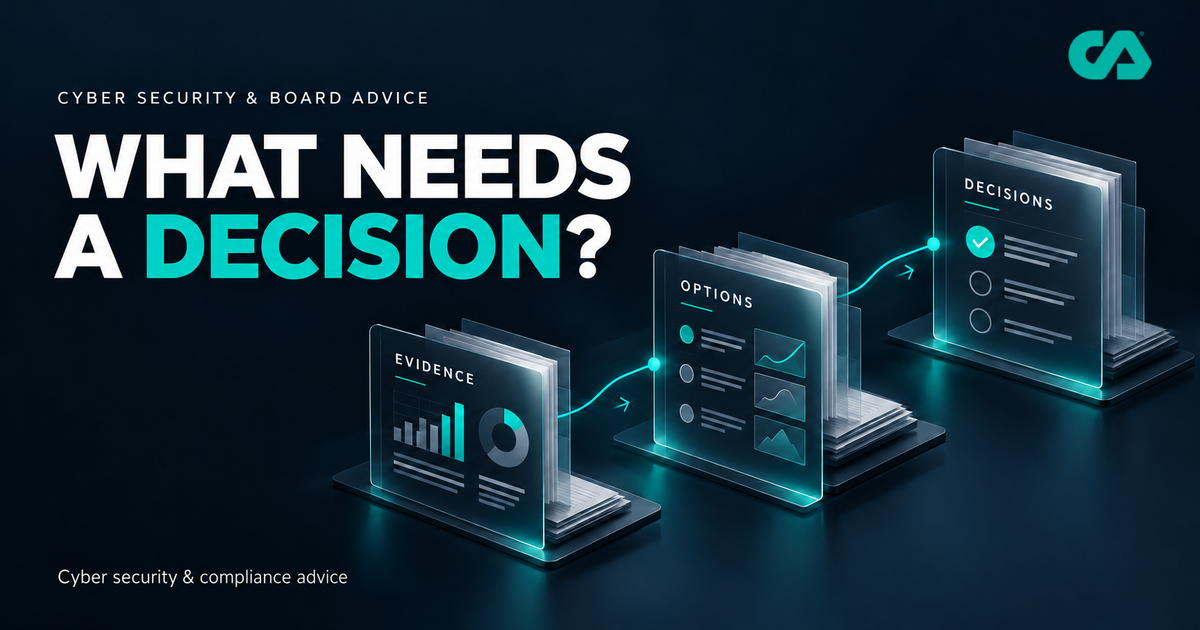
A board should expect cyber security and compliance advice to explain the business risks that matter, the evidence behind the assessment, the available options and the decisions required. Each significant action should have an owner, a target date and a clear way to check progress.
Technical dashboards can support that conversation. They do not complete it.
Our recent guide to testing a cyber incident response plan explored how a rehearsal reveals assumptions between people, technology and suppliers. Finding those gaps is valuable. The next question is what leadership does with them.
Perhaps an exercise showed that nobody could authorise containment outside office hours. Perhaps a recovery target has never been tested. Perhaps a supplier assurance response describes a control that covers only part of the organisation.
These findings need decisions about priorities, resources and acceptable exposure. That is where useful board-level advice begins.
Start with the business outcome at risk
“We have outstanding vulnerabilities” is a technical observation. A board needs to understand what could happen to the organisation and why it deserves attention now.
Explain which activity depends on the affected technology: paying staff, delivering a service, accessing records, processing orders or meeting a customer commitment. Describe the likely operational consequences and the important uncertainties. Use financial estimates only where the assumptions and evidence support them.
Avoid presenting every issue as equally urgent. A long list without priorities transfers the work of interpretation to people who may not have the technical context.
A useful opening is: “These are the three exposures that need leadership attention, and this is what has changed since the previous review.”
Separate evidence from assumptions
Security reporting becomes more useful when readers can see the basis of each conclusion.
Was the control configured, observed, tested or independently assessed? What was the scope? When was the evidence collected? What remains untested?
A completed backup job demonstrates a different thing from a successful recovery test. A documented leaver process demonstrates a different thing from checking that access was removed from the systems the person actually used.
Both process records and operational evidence have value. The report should make their limits visible.
For example: “Recovery was tested for the finance database on the stated date. Application access and the payroll integration were outside the test.” That statement gives leadership a more usable picture than a green recovery indicator with no explanation.
An uncertainty should create an action to obtain evidence, rather than quietly becoming a reassuring status.
Present options that leadership can compare
An adviser should help leadership understand the choices available.
For a material issue, set out the recommended action, alternatives, expected benefit, cost assumptions, delivery effort and dependencies. Explain the remaining exposure after the proposed work.
Sometimes a short-term safeguard is appropriate while a larger change is prepared. Sometimes a proposed project needs different sequencing because the internal IT team is already delivering another critical commitment.
The decision should be clear enough to record. “Improve identity security” is an ambition. “Approve a scoped review of privileged access, nominate the system owners and agree when the findings return for decision” is a defined next step.
That is the role of strategic IT and board advisory: connecting technical findings to business choices and a deliverable plan.
Give every significant decision an owner
An external provider can assess risk, recommend controls and deliver agreed work. The organisation's authorised leadership must remain visible in decisions about priorities, investment and accepted risk.
Record who makes the decision, who carries out the work and who checks the result. In a co-managed arrangement, those may be different people across internal teams and suppliers.
Include a deputy or escalation route where availability matters. An action without an owner often becomes an assumption that somebody else is progressing it.
Risk acceptance also needs a reason and a review point. If a temporary exception depends on a system being replaced, the report should show what happens when that replacement slips.
Explain what compliance assurance covers
Compliance reporting should identify the requirement, the parts of the organisation in scope and the evidence supporting the conclusion.
For an organisation operating across locations, that could mean distinguishing entities, services, systems and suppliers. A statement about one environment should not silently become a statement about the whole group.
Ask which requirements come from a standard, a customer contract, an internal policy or an applicable legal obligation. Confirm jurisdiction-specific questions with the relevant specialists.
This is also why certification and operational security need connected but distinct reporting. A certificate has a defined scope. Leadership still needs visibility of incidents, exceptions, changing systems and outstanding treatment actions.
Governance, risk and compliance consultancy should help make those boundaries and responsibilities understandable, including the evidence that is missing.
Use a concise decision summary with supporting detail
The following is an illustrative structure, not a client case study or a prescribed reporting standard.
| Field | Illustrative entry |
|---|---|
| Business concern | Customer service depends on access to a shared application |
| Evidence | The exercise found an unclear approval route for emergency account containment |
| Scope and uncertainty | The primary team took part; the overseas deputy has not rehearsed the process |
| Recommendation | Agree delegated authority and rehearse the handover with both teams |
| Decision required | Approve the authority boundaries and allocate time for the exercise |
| Accountable owner | Named operations leader, with technical actions assigned separately |
| Review point | Confirm completion and remaining gaps at the next agreed review |
Keep the first page focused on decisions, material changes and overdue actions. Supporting technical detail should remain accessible for challenge and investigation.
A concise summary should not conceal uncertainty or remove the evidence needed to question a recommendation.
Set a reporting rhythm and an escalation threshold
The UK's Cyber Governance Code of Practice, published on 8 April 2025, recommends formal reporting at least quarterly, with suitable metrics and tolerances linked to cyber strategy and risk appetite. This is UK guidance, not a universal legal reporting timetable.
Choose a cadence that fits your governance and obligations, and agree which events need earlier attention. A serious incident, material control failure or significant change in exposure should not wait for the next routine meeting.
Track whether agreed actions are complete and whether the intended improvement has been demonstrated. A closed project task does not necessarily mean the underlying risk has been reduced.
Make the next conversation easier to act on
Before the next board or leadership review, ask your adviser or internal team for five things:
- The business exposures that need attention.
- The evidence and its limitations.
- Practical options and a recommendation.
- The decisions, owners and resources required.
- The next review point and escalation triggers.
The aim is a conversation in which leadership can challenge assumptions and make informed choices, while technical teams leave with clear priorities.
Bring a clearer decision to your next leadership meeting. Cloud Agile's strategic IT consultancy can help turn technology risk, assurance findings and delivery priorities into an agreed roadmap and board reporting. Engagements can sit alongside internal IT teams and existing providers, with international delivery arrangements agreed in scope. Discuss your requirements with Cloud Agile.
FAQs
What should a cyber security board report include?
Include priority business risks, changes since the previous review, evidence of control effectiveness, significant exceptions, overdue actions and decisions required. Name the people responsible and explain the scope and limitations of the evidence.
How often should the board review cyber security?
Agree a regular cadence and a route for urgent escalation. The UK Cyber Governance Code recommends formal reporting at least quarterly. The appropriate arrangements also depend on the organisation's risks and applicable obligations.
Can an IT provider accept cyber risk on our behalf?
A provider can advise and operate within agreed delegated authority. Business decisions about accepted risk should follow the organisation's governance and authorisation arrangements. Record who approved the decision, why and when it will be reviewed.
Does ISO 27001 certification remove the need for board reporting?
No. Leadership still needs to understand changes, material risks and progress against agreed actions. Certification has a defined scope and does not replace ongoing management of the organisation's security and business priorities. Learn more about ISO 27001 consultancy.
Can board advisory work alongside our internal IT team?
Yes. Define the advisory role, information inputs, reporting cadence and decision responsibilities at the start. Technical delivery can remain with internal IT or existing suppliers, or include separately agreed specialist support.
How should an international organisation report cyber risk?
Use a consistent reporting structure while identifying the entities, locations, services and requirements covered. Make local exceptions, evidence gaps and escalation responsibilities visible, with specialist input for jurisdiction-specific obligations.
Bring a clearer decision to your next leadership meeting
Cloud Agile's strategic IT consultancy can help turn technology risk, assurance findings and delivery priorities into an agreed roadmap and board reporting.
Engagements can sit alongside internal IT teams and existing providers.
Discuss your requirements with Cloud Agile