How to Build ISO 27001 Evidence Across Distributed Teams
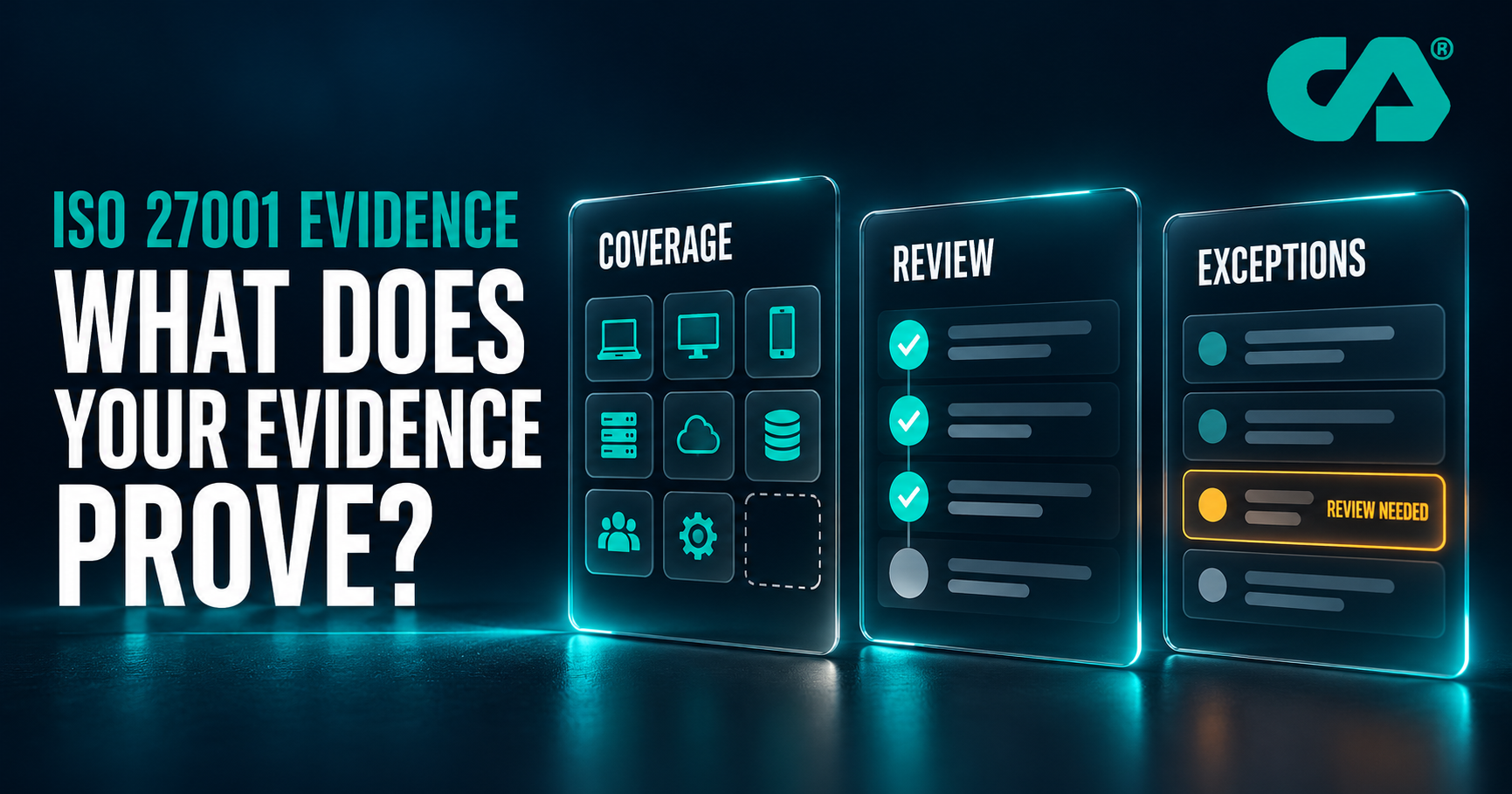
To build useful ISO 27001 evidence across distributed teams, define what each control is meant to achieve, which systems and people it covers, who produces the records and who reviews the result. Collect evidence through normal operations, record exceptions and keep the limits of each conclusion visible.
The objective is not a larger audit folder. It is a reliable way to understand whether the information security management system, or ISMS, is operating as intended.
Our scope discussion asked which entities, locations and services belong inside that system. The next question is practical: can each relevant team demonstrate its part, without a last-minute scramble before an audit?
ISO/IEC 27001 provides the management-system framework. The workflow below is a practical recommendation, not an ISO-prescribed template or a guarantee of certification.
Start with the claim, not the screenshot
“Access is reviewed” is too vague to guide evidence collection. Define which access, whose access, to what systems, over which period and against which requirement.
For example, a review might cover privileged accounts in a named tenant, checked by an authorised reviewer against current role requirements. The evidence should show the population considered, decisions made, changes requested and whether those changes were completed.
A screenshot can support that record. It cannot automatically explain why an account remained appropriate or whether an excluded application was reviewed elsewhere.
Separate three questions:
- Is the control designed appropriately?
- Is it implemented across the intended scope?
- Is it operating effectively over the relevant period?
A policy helps explain design. A configuration export may demonstrate implementation at a point in time. Review records, operational logs and test results can help assess operation. None should be presented as proving more than it actually does.
Build a small evidence register
Start with a manageable set of important controls, selected from the organisation's risks, requirements and treatment decisions. Map the evidence to the applicable Statement of Applicability and supporting processes rather than collecting material for every imaginable control.
An evidence register can contain:
| Field | What to record |
|---|---|
| Claim | The outcome or requirement being assessed |
| Coverage | Entities, systems, locations and population included |
| Control owner | Person accountable for operation |
| Evidence producer | Team or supplier providing the record |
| Reviewer | Person evaluating what the evidence demonstrates |
| Timing | Period covered, collection date and review trigger |
| Source | Controlled link to the authoritative record |
| Exceptions | Missing coverage, failures and limitations |
| Follow-up | Action owner, deadline and verification |
A spreadsheet or existing workflow tool may be sufficient initially. The register is an index, not a reason to duplicate every log or customer record into another platform.
Use stable references, sensible access controls and version history. A collection of attachments spread across email inboxes makes it difficult to establish which record informed a decision.
Agree common outcomes, not identical screenshots
Distributed teams may use different platforms or local providers. Requiring every team to submit the same screenshot can create administrative work without improving assurance.
Agree the evidence acceptance criteria instead.
For device security, that could mean identifying the expected device population, showing which devices are managed, recording the assessed settings and explaining missing or non-reporting devices. Different tools may produce different reports while supporting the same assessment.
Do not compare percentages until their denominators are understood. A report covering enrolled devices says little about devices absent from the management platform.
An illustrative example: a console reports that 96 of 100 enrolled laptops meet the chosen baseline. A separate asset reconciliation identifies 12 additional active laptops. The original percentage remains a statement about the enrolled population, not the full active fleet. The missing coverage requires investigation rather than a reassuring group-level average.
Make shared responsibility visible
In a co-managed arrangement, an internal team might approve access, a provider might execute the change and a compliance lead might review completion.
Each party needs to know what it produces and what happens if the evidence is incomplete.
For a leaver process, HR can provide the authoritative departure notification. Application owners can identify relevant access. IT can record the changes performed. A reviewer can check that the required systems were covered and unresolved items were escalated.
No single ticket necessarily proves the entire process worked.
Co-managed IT services should define the evidence handover alongside the operational responsibilities. Include service hours, escalation routes, record access and what happens when a supplier cannot produce the agreed information.
Avoid assigning the compliance lead responsibility for recreating operational evidence after the event. Evidence should come from the activity and its owners.
Choose review timing based on risk and change
There is no universal monthly screenshot schedule that makes an organisation ISO 27001 compliant.
Set collection and review arrangements appropriate to the control, the risk, applicable requirements and the speed of change. Some records are generated continuously. Others arise from a completed review, test, incident or change.
Distinguish:
- when the activity happened;
- the period the evidence covers;
- when the evidence was collected;
- when someone evaluated it;
- what would trigger an earlier reassessment.
A report generated today may describe last quarter. An access review completed last month may need revisiting after a reorganisation. A recovery test may no longer represent the service following a substantial platform change.
ISO's technical committee has published explanatory material on monitoring, measurement, analysis and evaluation under clause 9.1. The practical lesson is to plan what will be assessed and how the results will inform decisions, rather than gathering records without a purpose.
Treat exceptions as findings to manage
A control with exceptions is not automatically a failed programme. An exception hidden inside a green status is a governance problem.
Record whether a gap concerns missing evidence, incomplete coverage, a failed control or a justified variation. Those are different situations and may need different responses.
Use clear language:
“Evidence received for two of three entities. The third entity's application review is outstanding. Its owner has an agreed deadline, and the remaining uncertainty has been escalated.”
That is more useful than “access review complete” because most teams replied.
If risk is accepted temporarily, record the authorised decision, rationale, safeguards and review point. Do not treat a missing document as proof that a control failed, or a missing failure report as proof that it worked.
Automate collection without automating reassurance
Automation can reduce repetitive exports and reminders. It can also repeat a mistaken assumption more efficiently.
Before relying on an automated feed, check its scope, permissions, filters, refresh time and failure behaviour. Confirm that new entities, tenants or devices enter the expected population. Monitor the collection mechanism itself.
Use human review where the meaning requires judgement. A tool can identify inactive accounts, but someone must decide whether access is still justified. A platform can report a deployment, but service owners may need to verify that the application works and that the relevant exposure has been addressed.
If AI is used to summarise evidence, keep the underlying sources traceable. Do not let a fluent summary turn incomplete data into a confident assurance statement.
Protect the evidence you collect
Security evidence can reveal account names, sensitive configuration, customer information and weaknesses. Collect only what is necessary and restrict access according to role.
Keep detailed operational records in controlled systems where practical. Use redacted or minimised extracts for wider assurance requests, preserving enough context to support the conclusion. Do not change records to conceal a finding.
Agree retention and deletion based on business need and applicable obligations. International transfers or sensitive personal data may require specialist advice. Do not assume that one retention period or sharing method is suitable for every location.
An external assessor may need more detail than a sales prospect. Prepare appropriate access routes rather than sending the same unrestricted folder to everyone.
Report confidence and limitations to leadership
Leadership does not need every screenshot. It needs to understand the conclusions, their basis and the decisions required.
A concise review can show:
- controls assessed and populations covered;
- material exceptions and missing evidence;
- changes since the previous review;
- overdue actions and business implications;
- decisions needed, with named owners;
- planned verification after remediation.
Distinguish control monitoring from internal audit and specialist technical testing. They contribute different kinds of assurance. An evidence register does not replace an objective internal audit, and a configuration record does not prove that an attack would be detected or contained.
That distinction creates the next useful question: which important security assumptions should be tested directly?
Start with one control across the whole scope
Choose one material control, such as privileged-access review or leaver access removal. Define the expected outcome and the complete relevant population.
Agree who operates it, who supplies records and who reviews the result. Run one collection cycle across the relevant teams. Investigate missing coverage, resolve unclear handovers and verify agreed actions.
Then expand the approach.
ISO 27001 consultancy can help connect scope, risk treatment and evidence requirements. Governance, risk and compliance support can help turn that into a repeatable operating rhythm alongside internal teams and providers.
Make your next assurance review easier to defend. Discuss your evidence and control-review requirements with Cloud Agile. Consultancy, implementation and co-managed responsibilities are agreed for the engagement. Certification decisions remain with an independent certification body.
Frequently asked questions
What counts as ISO 27001 evidence?
Relevant policies, approvals, operational records, reviews, logs, test results and corrective-action records can contribute. Their value depends on the requirement, scope, period and conclusion they support. There is no universal folder that proves every organisation complies.
Are screenshots enough for an ISO 27001 audit?
Sometimes a screenshot supports a specific observation, but it may not establish coverage, sustained operation or completed follow-up. Keep context and source records so the assessor can understand what it demonstrates.
How often should we collect evidence?
Set timing according to risk, change, control design and applicable requirements. Separate collection from review. A monthly report is not automatically sufficient, and some evidence is generated by events rather than a calendar.
Can suppliers provide evidence?
Yes, where their work supports the relevant controls. Agree content, timing, access and escalation. Review the supplier's evidence for relevance and limitations rather than assuming an assurance statement covers your particular service.
Do all locations need the same evidence format?
Not necessarily. Common acceptance criteria and clear scope matter more than identical screenshots. Different systems can produce different records that demonstrate the same required outcome.
Does a complete evidence register prove we are secure?
No. It helps organise assurance and identify gaps. Evidence must be evaluated, findings addressed and important assumptions tested. It does not replace internal audit, risk management or appropriately scoped technical assessment.