Where Should Your Business Start with AI?
In our previous article, we considered whether your technology is simply working or actively making your business more efficient.
Once repetitive administration, disconnected systems or slow processes have been identified, it can be tempting to assume artificial intelligence must be the answer.
Sometimes it will be.
In other situations, better use of Microsoft 365, a straightforward workflow or an integration between existing systems may produce a quicker and more reliable result.
The best place to start with AI is one clearly defined business problem where the time, cost and expected improvement can be measured.
Effective AI consultancy starts with the process, not the product.
What does an AI consultant do?
An AI consultant helps a business identify where artificial intelligence and automation could create measurable value, then introduces the most appropriate technology securely.
This normally involves:
- Reviewing how employees currently work
- Identifying repetitive or time-consuming tasks
- Assessing existing systems and data
- Prioritising realistic use cases
- Considering security and data-protection risks
- Selecting suitable technology
- Running a controlled pilot
- Training employees
- Measuring adoption and return on investment
The objective should not be to introduce AI everywhere. It should be to find the areas where it can make a genuine difference.
How widely are UK businesses using AI?
AI adoption is increasing quickly, but many businesses are still at an early stage.
The Office for National Statistics reported in July 2026 that around 35% of UK businesses with ten or more employees were using at least one AI technology, up from around 12% in late 2023.
However, only 10% of businesses already using AI described their use as extensive. The average number of AI technologies used by adopters had also increased only modestly, suggesting that many organisations are experimenting rather than embedding AI throughout their operations. View the latest ONS analysis.
For SMEs across Suffolk, Essex, Hertfordshire and London, the opportunity is not simply to "start using AI".
It is to move from informal experimentation towards secure, controlled and measurable adoption.
Where should a business look for AI opportunities?
Begin by speaking to the people completing the work.
Ask employees:
- Which tasks do you repeat every day or week?
- Where do you copy information between systems?
- Which reports take too long to prepare?
- What information is difficult to find?
- Which emails or documents follow a predictable format?
- Where do mistakes or delays regularly occur?
- What prevents you from completing more valuable work?
These questions often reveal stronger opportunities than starting with a discussion about a particular AI product.
For example, this could mean:
- A Suffolk logistics business extracting information from delivery documents
- An Essex professional-services firm preparing repetitive client reports
- A Hertfordshire company searching across years of SharePoint content
- A London agency producing similar proposals for multiple clients
- A care provider summarising structured administrative notes
- A finance team manually processing invoices or supplier information
The industries and locations may differ, but the underlying issue is often the same: skilled employees are losing time to predictable, repetitive work.
What makes a good first AI project?
A suitable first project normally has four characteristics.
The task happens frequently
Saving ten minutes from something completed once a year will provide little value.
Saving ten minutes from a task completed hundreds of times each month could release meaningful capacity.
The desired outcome is clear
"Use AI to improve productivity" is too broad to measure.
"Reduce weekly report preparation from four hours to one hour" provides a clear objective.
The information is already digital
AI and automation are easier to implement when information already exists within documents, emails, forms, databases or Microsoft 365.
Processes based on inconsistent records or poor-quality data may need to be improved before AI is introduced.
A person can review the result
Good initial projects usually support employees rather than making high-risk decisions without human oversight.
UK government research found that most businesses using AI applied some form of human checking to its outputs. Data security and the accuracy of AI-generated content were also among the primary concerns identified by businesses. Read the government's AI Adoption Research.
Does every process need AI?
No.
One of the most useful recommendations an AI consultant can make is:
You do not need AI for this.
A predictable approval process may be better suited to Power Automate.
Repeated data entry might be removed by connecting two existing applications.
Difficulty finding documents might require a clearer SharePoint structure.
Poor software adoption may be resolved through configuration and employee training.
AI is particularly useful where language, documents, knowledge, variation or interpretation are involved. Traditional automation is often more appropriate where a process follows consistent rules.
The solution should follow the requirement, rather than the latest technology trend.
Is your business data ready for AI?
Before deploying Microsoft Copilot or another business AI platform, an organisation should understand how information is stored, shared and protected.
Microsoft recommends reviewing oversharing, identifying high-risk SharePoint sites, introducing appropriate guardrails and addressing regulatory requirements before wider Copilot deployment. View Microsoft's secure Copilot deployment guidance.
Businesses should consider:
- Who can access confidential documents
- Whether SharePoint sites have active owners
- How external sharing is controlled
- Whether old or unnecessary access remains
- What information employees can enter into public AI tools
- How AI-generated answers will be checked
- Whether an acceptable-use policy is in place
- How personal and commercially sensitive information is protected
The Information Commissioner's Office also provides an AI and data-protection risk toolkit to help organisations assess risks to individuals when developing or using AI systems. The ICO notes that parts of its guidance are currently under review following changes introduced by the Data (Use and Access) Act, so businesses should refer to the latest published version.
How should an SME run an AI pilot?
A business does not need to deploy AI to every employee immediately.
A controlled pilot provides a safer and more commercially sensible starting point:
- Choose one clearly defined process.
- Record how long it currently takes.
- Select a small group of employees.
- Review the data and security requirements.
- Configure the technology.
- Provide task-specific training.
- Measure time saved, accuracy and adoption.
- Decide whether to expand, change or stop.
This allows the business to test the assumptions before committing to wider licensing or a larger implementation.
It may also reveal that the main obstacle is not the AI itself, but the process, data quality, permissions or employee adoption.
How does managed IT support fit alongside AI consultancy?
AI should not be treated as separate from the rest of a company's technology environment.
A secure AI programme may depend on:
- Microsoft 365 configuration
- Identity and access management
- SharePoint permissions
- Data-loss prevention
- Device security
- Software licensing
- Employee support
- Ongoing governance and monitoring
This is where combining AI consultancy with managed IT support can be particularly valuable.
A managed IT provider already has visibility into recurring support issues, the software employees use and the security controls protecting company information.
That day-to-day understanding can help identify potential automation opportunities while ensuring that new tools remain secure, supported and properly maintained after the initial project.
Rather than delivering a one-off AI demonstration and walking away, the project can become part of the organisation's wider technology roadmap.
Book your AI readiness check today
Book directly from this article and get 25% off your AI readiness check — a short, practical session to identify where AI could save your business time, reduce risk and deliver measurable ROI.
Claim your 25% discount →Discount applied automatically when you book via this link.
AI consultancy across Suffolk, Essex, Hertfordshire and London
Cloud Agile provides practical AI consultancy and automation services to SMEs across Suffolk, Essex, Hertfordshire, London and the wider UK.
With a presence in Ipswich and Harpenden, alongside support for businesses throughout Essex and London, we can combine regional knowledge with remote delivery and ongoing managed support. Cloud Agile's website currently lists offices in Ipswich, Harpenden and Milton Keynes, with Harpenden providing a clear service presence for Hertfordshire businesses.
We help organisations:
- Identify suitable AI and automation opportunities
- Assess Microsoft Copilot readiness
- Build Power Automate workflows
- Develop secure, business-specific AI agents
- Review SharePoint access and data governance
- Create practical AI acceptable-use policies
- Train employees and support adoption
- Measure whether the investment is delivering value
- Integrate AI into a wider managed IT and technology strategy
Our approach begins with where the business is losing time — not with a predetermined product.
Frequently asked questions
Where should a small business start with AI?
Start with one frequent, time-consuming process where the current cost and expected improvement can be measured. Avoid buying licences for the whole business before a suitable use case has been tested.
Is Microsoft Copilot suitable for every employee?
Not necessarily. Copilot is more likely to provide value for employees who regularly work with emails, meetings, documents and Microsoft 365 information. A targeted pilot is often more cost-effective than licensing every user immediately.
Do we need an AI policy?
Businesses should have clear guidance explaining which AI tools are approved, what information employees may enter, how outputs must be checked and who remains accountable for decisions.
Can AI consultancy work alongside our existing IT provider?
Yes. AI consultancy can support an internal IT team or an existing managed provider. Clear responsibility will be needed for identity, permissions, security, implementation and ongoing support.
Do you provide AI consultancy in Hertfordshire?
Yes. Cloud Agile supports businesses across Hertfordshire through its Harpenden presence, alongside services in Suffolk, Essex, London and throughout the UK.
Start with the problem, not the product
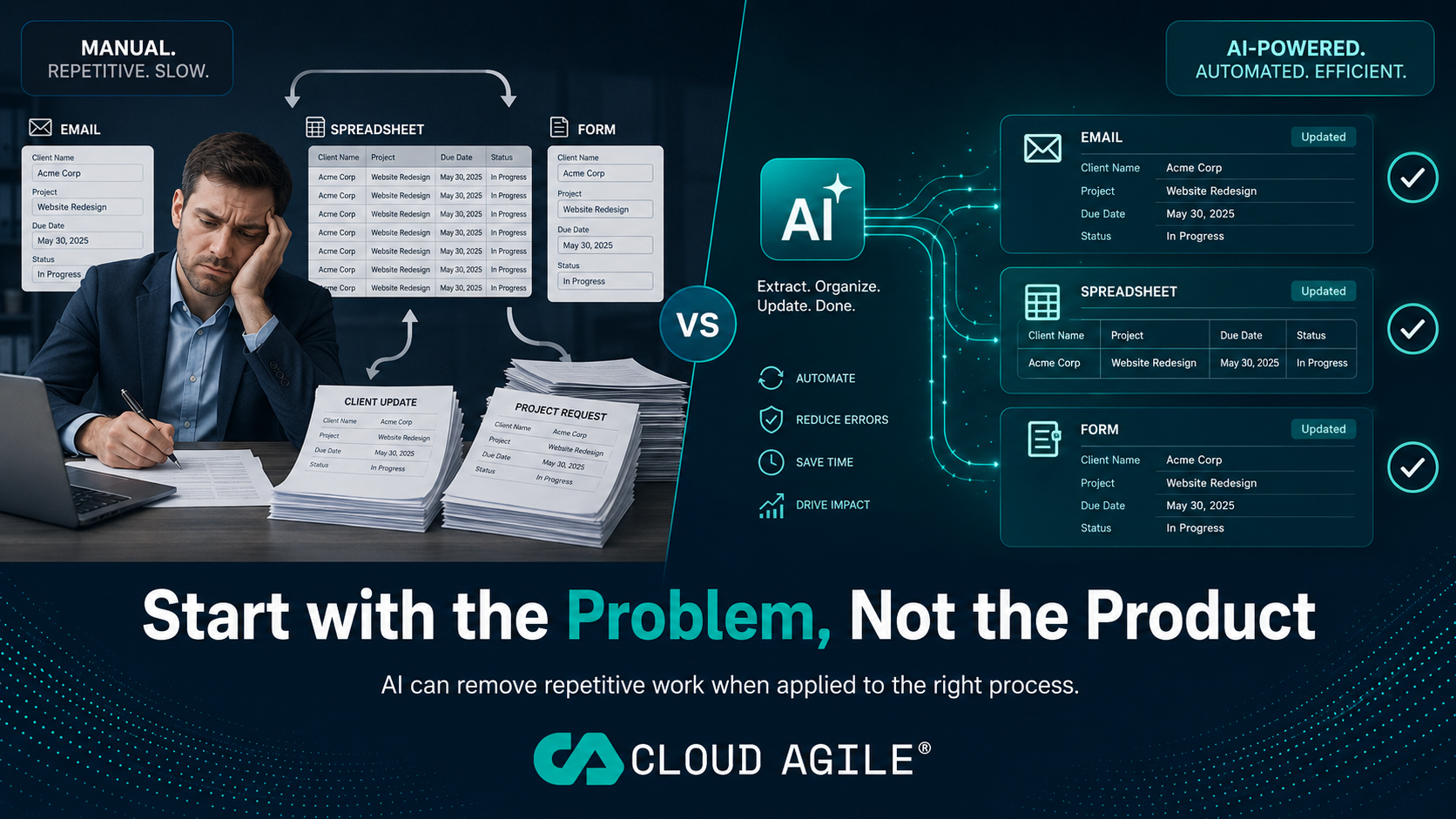
AI can reduce administration, improve access to information and help employees focus on higher-value work.
But purchasing an AI licence without understanding the process, data, risk and expected outcome is unlikely to create meaningful change.
A successful project begins with a clearly defined problem, the simplest appropriate solution and a method for measuring whether the result justifies further investment.
At Cloud Agile, we combine AI consultancy with strategic guidance, cyber security and managed IT support. This gives businesses one accountable team that can identify the opportunity, deliver the technology and support it afterwards.
Explore our services:
- AI Consultancy and Automation
- Managed IT Support
- Strategic IT Consultancy
- IT Services in Suffolk
- IT Services in Essex
- IT Services in London
- Book an IT Consultation
Book your AI readiness check today
Get 25% off your AI readiness check when you book directly from this article — no code required.
Claim your 25% discount →Discount applied automatically when you book via this link.
Sources and further reading
Related reading
AI vs Automation: How Managed IT Support Helps You Choose
AI is not always the answer. Learn when a business process needs traditional automation, artificial intelligence or simply better managed IT support.
Who Owns Cyber Security When You Outsource IT Support?
Outsourcing IT support can transfer much of the day-to-day cyber security work to a specialist provider, but not the business accountability. Here is how to…
What Does Proactive IT Support Actually Mean?
Proactive IT support should prevent problems, not just fix them. Here is what a managed IT provider should monitor, maintain and improve every month, and how…
How to Choose an IT Support Provider in Suffolk, Essex and Milton Keynes
A practical buying guide for UK SMEs comparing IT support providers: what to compare, how managed, co-managed and break-fix models differ, a sample scorecard…