Does Managed IT Support Include Cyber Security? A Guide for Suffolk and Essex SMEs
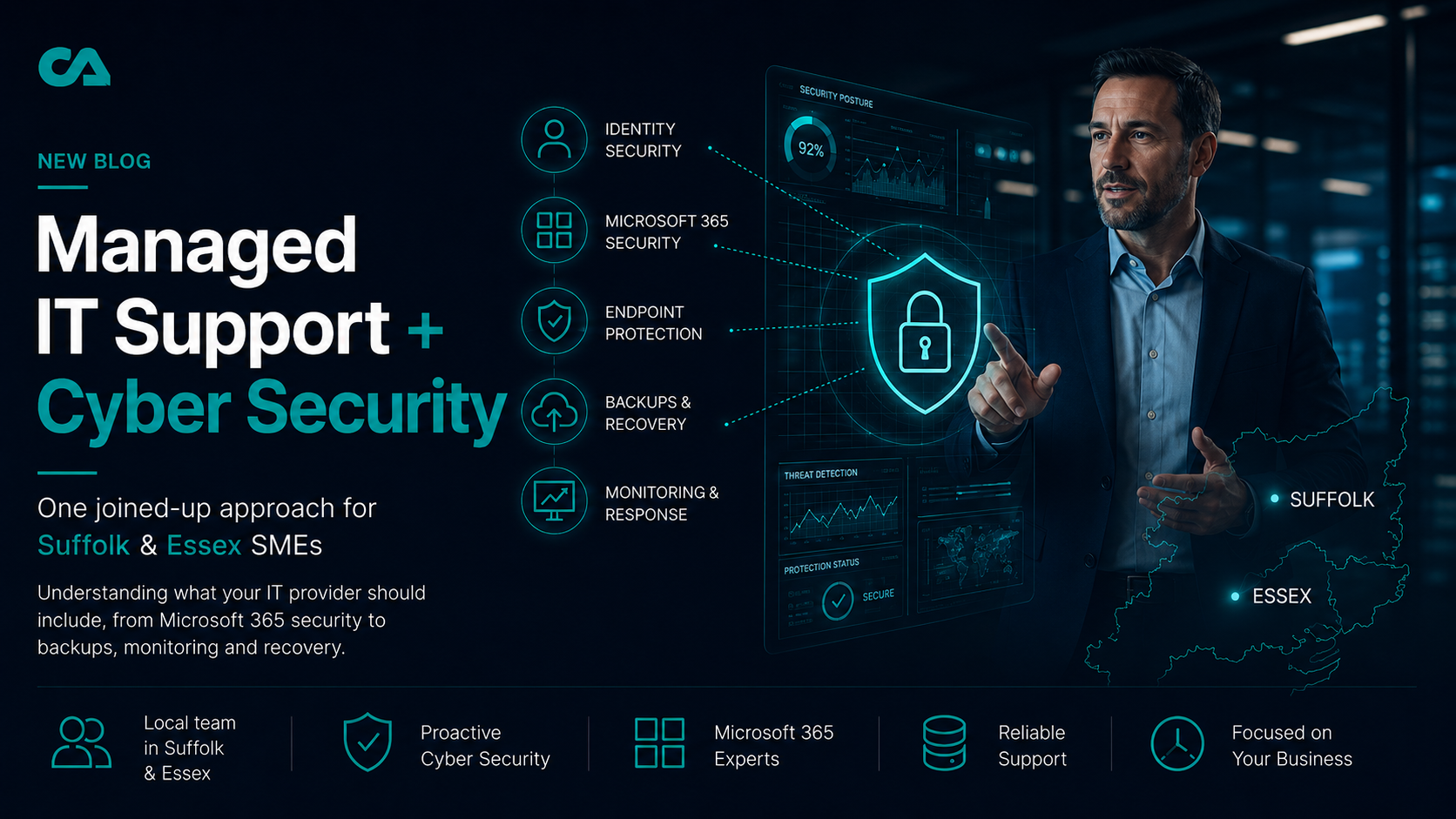
For many SMEs, IT support and cyber security are still purchased and discussed as though they are completely separate services. In reality, they overlap every day.
The same IT provider managing your laptops, Microsoft 365 environment, user accounts, permissions, software updates and backups already controls many of the things that determine how secure your organisation is.
So, does managed IT support include cyber security?
Yes. Modern managed IT support should include core cyber security controls such as patching, endpoint protection, identity security, multi-factor authentication, Microsoft 365 security, access management and backup oversight. More advanced requirements, including Managed Detection and Response, penetration testing, compliance and formal risk assessments, may require additional specialist cyber security services.
For organisations across Suffolk and Essex, the important question is not simply whether you have an IT provider and a collection of security products. It is whether somebody has clear responsibility for keeping the whole environment supported, secure and recoverable.
\n\nWhat Managed IT Support Should Include for Suffolk and Essex SMEs
A good managed IT support package for organisations in Suffolk and Essex should not treat cyber security as an optional extra. The table below summarises the core inclusions a provider should manage as standard, and the security proof points that should back them up.
| Service area | What should be included | Security proof point |
|---|---|---|
| Day-to-day IT support | Helpdesk, user account management, device setup, password resets, software installation | Clear response and resolution targets by priority |
| Microsoft 365 management | Entra ID, MFA, mailbox security, SharePoint permissions, licence management | Follows Microsoft 365 security best practices |
| Endpoint protection | Antivirus/EDR, patching, device encryption, policy enforcement | NCSC device protection guidance aligned |
| Backup and recovery | Monitored backups, recovery testing, retention policies, offsite or cloud copies | Tested recovery process with defined recovery objectives |
| Network and connectivity | Firewall configuration, Wi-Fi security, remote access, VPN | Secure configuration and regular review |
| Strategic IT guidance | Roadmap planning, risk review, technology budgeting, vCIO input | ISO 27001 and Cyber Essentials informed approach |
Local Security Proof Points for Suffolk and Essex Organisations
- ISO 27001 certified — information security management independently audited to UKAS standards.
- Cyber Essentials certified — baseline cyber hygiene verified through IASME.
- Microsoft Partner — direct access to Microsoft tools, licensing and security frameworks.
- NCSC-aligned approach — controls mapped to National Cyber Security Centre guidance for small organisations.
- Regional delivery — remote-first support with onsite visits available across Suffolk and Essex, including Ipswich, Bury St Edmunds, Colchester, Chelmsford and surrounding areas.
Why IT Support and Cyber Security Are Closely Connected
Consider the routine responsibilities of an IT support provider:
- Creating user accounts
- Setting up laptops
- Managing Microsoft 365
- Configuring permissions
- Resetting passwords
- Installing software
- Deploying security updates
- Managing administrator accounts
- Onboarding employees
- Removing access when employees leave
- Monitoring backups
- Supporting remote and hybrid workers
Almost every one of these tasks has a security consequence. A forgotten account creates risk. A poorly configured permission can expose information. A missing update can leave a vulnerability open. A backup that has never been tested may provide little comfort during a ransomware incident.
Cyber security should therefore be part of normal IT management. It should not only appear as an additional product on an invoice.
What Cyber Security Should Managed IT Support Include?
A modern managed IT service should cover fundamental security controls as part of normal operations.
Identity and Multi-Factor Authentication
Businesses should expect their IT provider to help manage:
- MFA
- Microsoft Entra ID
- Administrator access
- User permissions
- New starters and role changes
- Secure offboarding
- Suspicious login investigation
- Conditional Access where appropriate
Microsoft publishes clear security best practices for Microsoft 365 business environments that a competent provider should already be working towards.
Endpoint Security and Patching
Every employee device represents a potential route into company systems. Managed IT support should therefore include endpoint protection, EDR where appropriate, operating system patching, third-party application updates, device health monitoring, encryption, device policies and the removal or replacement of unsupported software. The NCSC guidance on protecting your devices is a sensible baseline for smaller organisations.
Microsoft 365 Security
For many SMEs in Suffolk and Essex, Microsoft 365 has become the centre of the IT environment. It may hold email, customer information, Teams communications, SharePoint and OneDrive content, financial documents, commercial information and employee data.
Managing Microsoft 365 should therefore include security, not simply password resets and licence provisioning. A managed provider should be considering MFA, identity security, administrator privileges, external sharing, SharePoint permissions, inactive accounts, email security, Conditional Access and user lifecycle management. This normally sits alongside wider cloud and Microsoft 365 management.
Antivirus Is Not a Cyber Security Strategy
Endpoint protection is important. It is only one layer. A business also needs to think about identity security, email protection, Microsoft 365, user access, security patching, backups, monitoring, incident response, business continuity and employee awareness.
A better question than "Do we have antivirus?" is "What happens if one of our security controls fails?" What happens if a Microsoft 365 account is compromised? What happens if an administrator account is breached? What happens if company data is encrypted? What happens if the backup needed to recover the business does not work?
Good cyber security is about understanding these scenarios before they happen.
Backup and Recovery Are Part of Cyber Security
Managed IT support should be able to answer:
- What is backed up, and how frequently?
- How long is the information retained?
- What happens when a backup fails, and who reviews failures?
- Is important Microsoft 365 data protected?
- When was the last recovery test?
- How long would critical systems take to restore?
The NCSC guidance on backing up your data covers the basics well.
A successful backup proves that data was copied. A successful recovery test proves that the business can use it.
Why Cyber Security Matters for Suffolk and Essex SMEs
Suffolk and Essex contain a wide mix of organisations that rely heavily on technology, including professional services firms, logistics and freight operators, care providers, charities and non-profit organisations, accountancy firms, legal practices and growing multi-site businesses.
The industries differ, but the technology risks are often similar: Microsoft 365 account compromise, phishing, data loss, business email compromise, ransomware, unpatched devices, weak supplier access and backup or recovery arrangements that have never been properly tested.
The UK Government's Cyber Security Breaches Survey 2025/2026 reports that 43% of UK businesses identified a cyber security breach or attack in the previous 12 months. It is worth noting that identified breaches are not necessarily all breaches, so the practical picture is likely to be broader than the figure suggests.
Managed IT Support and Cyber Security in Suffolk
Cloud Agile supports organisations across Suffolk, including businesses around Ipswich, Stowmarket, Felixstowe and Bury St Edmunds. Support is delivered remotely with onsite attendance where it is genuinely useful, rather than from an office in every town.
Suffolk businesses commonly need help across Microsoft 365, day-to-day user support, devices, networks, security, backup and recovery, remote and onsite assistance and longer term technology planning. Organisations around Felixstowe may also have multi-site, logistics or freight requirements where connectivity between locations and secure access for operational staff matter as much as the helpdesk.
You can see how we work with local organisations on our pages for managed IT support in Suffolk and IT support in Ipswich.
For Suffolk SMEs, the strongest IT support model is often one where day-to-day support, Microsoft 365, cyber security and recovery are managed as one joined-up service rather than several disconnected contracts.
Managed IT Support and Cyber Security in Essex
Cloud Agile supports SMEs across Essex, including organisations around Colchester, Chelmsford, Braintree, Witham, Basildon and Southend. As with Suffolk, this is a remote-first service with onsite support arranged where it adds value.
Essex businesses typically need a combination of managed IT support, Microsoft 365 management, cyber security, secure hybrid working, device management, backup and recovery, IT consultancy and help absorbing growth or additional sites without rebuilding everything each time.
Our page on managed IT support in Essex explains the model in more detail, and organisations looking specifically at security can start with our cyber security services in Essex and the wider UK.
For growing businesses in Essex, the challenge is often not finding another security product. It is creating clear ownership across support, Microsoft 365, devices, security and recovery.
When Does a Business Need Specialist Cyber Security Services?
Managed IT support should provide a strong security foundation. Some organisations require deeper capabilities such as Managed Detection and Response, SOC services, vulnerability management, penetration testing, incident response, Cyber Essentials, Cyber Essentials Plus, ISO 27001, risk assessments, supplier security reviews and formal security policies.
The appropriate level depends on business size, sector, customer requirements, contracts, data, regulation and risk tolerance. The objective should be proportionate protection, not buying every cyber security product available. Where certification and formal assurance are involved, that work usually sits with governance, risk and compliance, supported by strategic IT consultancy so investment follows a plan.
Eight Questions to Ask Your IT Provider About Cyber Security
- Who monitors our security alerts?
- What happens to a serious security alert outside normal business hours?
- How are administrator accounts protected?
- How quickly are critical security updates deployed?
- Who checks failed backups, and when did we last test recovery?
- How is our Microsoft 365 environment secured?
- What happens if we suffer a cyber incident?
- Can you explain our biggest cyber risks in plain business terms?
If these questions are difficult to answer, you may have IT support, but not necessarily a joined-up approach to managed security.
Why Cloud Agile Combines Managed IT Support and Cyber Security
At Cloud Agile, managed IT support and cyber security are designed to work together. Day-to-day support provides visibility into devices, employees, Microsoft 365, permissions, recurring incidents, software, backups, security alerts and joiners and leavers.
Cyber security and consultancy then provide a wider view of risk, identity, monitoring, recovery, vulnerabilities, governance, compliance and future priorities. This gives clients clearer ownership across the technology environment.
Managed IT support keeps the environment working. Cyber security helps make sure it can keep working when something goes wrong.
Cloud Agile provides managed IT support and cyber security services to SMEs across Suffolk, Essex and the wider UK.
Frequently Asked Questions
Does Managed IT Support Include Cyber Security?
Yes. Modern managed IT support should include fundamental cyber security controls including patching, endpoint protection, identity management, MFA, Microsoft 365 security, access management and backup oversight.
What Cyber Security Should an IT Provider Manage?
An IT provider should normally manage core controls associated with the systems it supports, including user identities, devices, software updates, Microsoft 365 security, administrator access, endpoint protection and backup monitoring.
Do You Provide Managed IT Support in Suffolk?
Yes. Cloud Agile provides IT support in Suffolk for SMEs, including organisations in and around Ipswich, Stowmarket, Felixstowe and Bury St Edmunds. Services can include day-to-day support, Microsoft 365, device management, cyber security, monitoring and strategic IT guidance.
Do You Provide Cyber Security Services in Suffolk?
Yes. Cloud Agile provides cyber security services for Suffolk organisations, including endpoint protection, identity security, security monitoring, Microsoft 365 security, vulnerability management and wider cyber security consultancy.
Do You Provide Managed IT Support in Essex?
Yes. Cloud Agile provides business IT support in Essex for SMEs, including businesses around Colchester, Chelmsford, Braintree, Witham, Basildon and Southend.
Do You Provide Cyber Security Services in Essex?
Yes. Cloud Agile supports Essex businesses with cyber security services including identity security, endpoint protection, Microsoft 365 security, monitoring, vulnerability management and cyber security consultancy.
Is Antivirus Enough for an SME?
No. Antivirus is one layer of protection. SMEs should also consider identity security, MFA, email protection, software updates, backups, access management, monitoring and incident response.
Can Cloud Agile Work Alongside Our Existing IT Provider?
Yes. Cloud Agile can deliver cyber security, consultancy and co-managed IT services alongside an internal IT team or incumbent IT provider.
Is Your IT Support Managing Your Cyber Risk Too?
Whether your business is based in Suffolk, Essex or elsewhere in the UK, you should be able to clearly understand who is responsible for your IT support, Microsoft 365, security and recovery. Cloud Agile can review your existing environment and provide a practical view of what is working well and where there may be gaps.
No hard sell. No obligation to change provider.
Talk to Cloud AgileRelated reading
What Should Managed IT Support Actually Include?
What SMEs should expect from proactive support, Microsoft 365 management and security.
7 Signs Your Business Needs More Than IT Support
When day-to-day support is no longer enough and technology needs strategic direction.
Why UK SMEs Should Outsource Their IT Support
When outsourcing makes sense, what it should cost and how to choose a UK partner.
What Is an MSSP? A Guide for UK SMEs
How managed security differs from IT support, and what to look for in a provider.
How to Spot a Phishing Email
The everyday email patterns your team should learn to question before clicking.
The Hidden Risks Inside Your Microsoft 365 Tenant
Tenant settings and retention gaps that often sit outside a basic support contract.
Related services
Managed IT Support
Helpdesk, proactive monitoring, patching and Microsoft 365 management for UK SMEs.
Cyber Security
Endpoint protection, identity security, MFA and vulnerability management as standard.
Governance, Risk & Compliance
Cyber Essentials, ISO 27001 and supplier assurance handled as a business conversation.
Backup & Disaster Recovery
Tested recovery for Microsoft 365, servers and critical line-of-business systems.
Managed IT Support and Cyber Security Near You
We support organisations remotely across the UK, with onsite cover in the regions below.