7 Signs Your Business Needs More Than IT Support
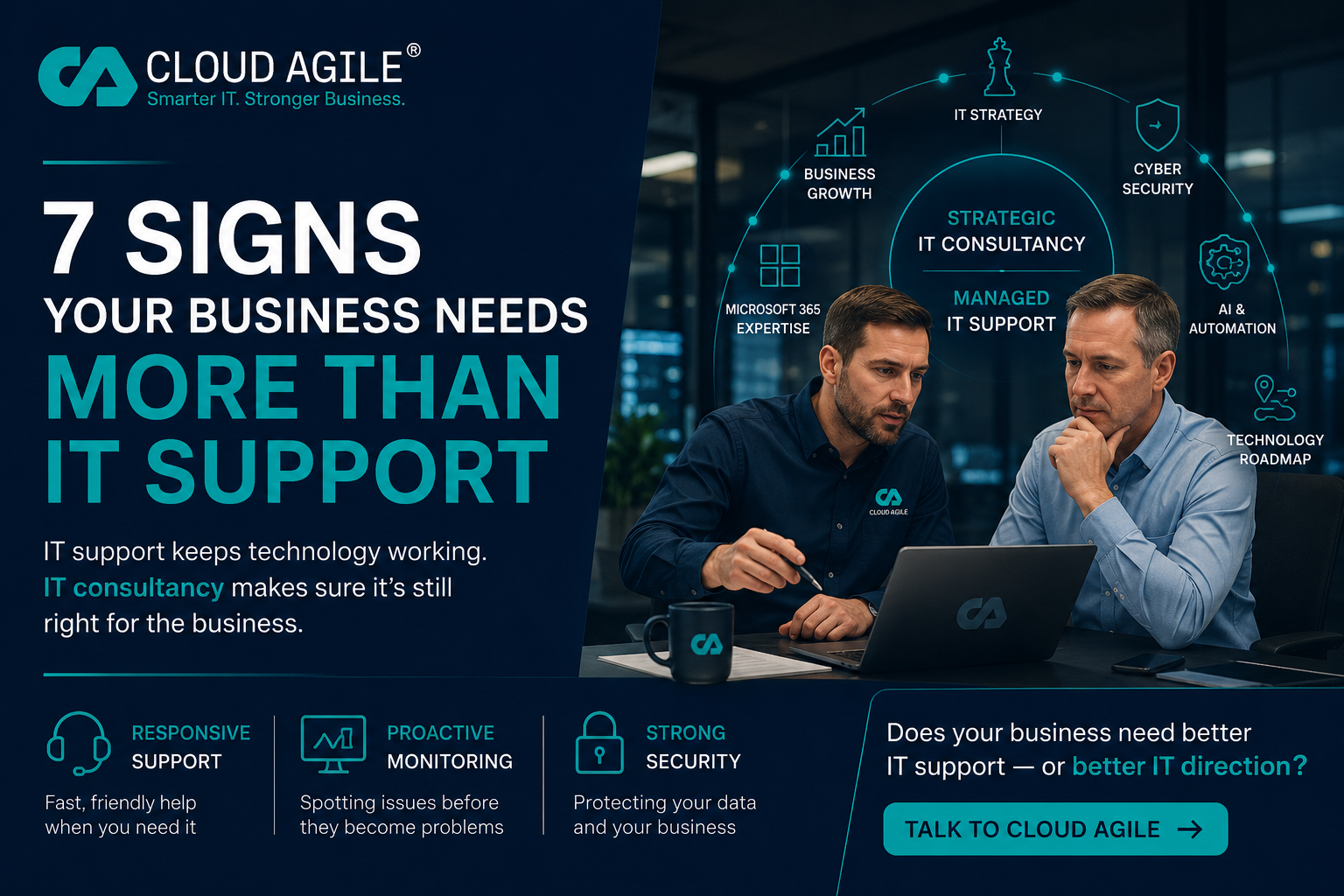
IT support and IT consultancy solve different problems.
IT support keeps technology secure, available and working for employees. IT consultancy asks a different question: is the technology still right for the business?
As organisations grow, technology decisions become more complex. New systems are added, Microsoft 365 environments expand, cyber risks increase and AI or automation projects begin to appear.
At that point, day-to-day support may still be good, but the business can start needing something more strategic.
For many SMEs, the strongest model is a combination of both. Managed IT support provides the operational foundation, while strategic IT consultancy helps shape what happens next.
Here are seven signs your business may need more than technical support alone.
1. Your IT Works, But Nobody Is Asking Whether It Could Work Better
A support team may be successfully resolving tickets every day. Email works, devices are online and applications are accessible.
But nobody is asking:
- Are employees wasting time on repetitive tasks?
- Are we paying for software we barely use?
- Are the same problems appearing repeatedly?
- Could Microsoft 365 be configured more effectively?
- Are there opportunities to simplify how teams work?
A functioning IT environment is important, but working technology is not automatically efficient technology.
This is where IT consultancy adds value. A consultant should look beyond whether the systems are operational and consider whether technology is actively helping the business perform better. Our article on whether your IT is making your business more efficient covers the recurring processes that quietly cost teams hours.
2. Technology Decisions Are Being Made Reactively
A server needs replacing. A contract is about to renew. Someone asks for Microsoft Copilot. A cyber insurer requests another control. A new office needs to open.
Suddenly, another urgent technology decision needs to be made.
This is common when there is no clear technology roadmap. A good IT consultancy should help leadership decide what needs to happen before it becomes urgent.
That includes:
- Prioritising projects
- Planning budgets
- Managing hardware lifecycles
- Reviewing software and licensing
- Understanding dependencies
- Identifying security improvements
- Preparing for business growth
The objective is to move technology planning from reactive decisions to an agreed roadmap, which is the core of our vCIO strategic IT consultancy.
3. Your Business Has Changed, But Your IT Strategy Has Not
The IT environment that worked for a 20-person business may not be appropriate for an 80-person organisation.
Growth can introduce:
- More employees
- Additional offices
- Remote and hybrid working
- More customer data
- More complicated Microsoft 365 permissions
- Larger contracts
- Increased cyber security requirements
- Additional compliance obligations
- More software platforms
- Increased dependency on technology
Technology often grows gradually around the business. Over time, this can create duplicated systems, inconsistent processes and technical debt.
An IT consultant should help review whether the current environment still supports where the organisation is going.
4. You Are Spending More on Technology Without Knowing Whether It Is Delivering Value
Technology spending has a habit of accumulating. Businesses may pay for:
- Microsoft 365 licences
- Cloud applications
- Cyber security tools
- Backup platforms
- Telecoms
- SaaS products
- Specialist line-of-business systems
- Project tools
- AI services
Each individual purchase may have made sense at the time. The challenge is that nobody may be looking at the overall picture.
IT consultancy should connect technology expenditure to business outcomes. Useful questions include:
- Are we paying for duplicate functionality?
- Are licences actually being used?
- Which systems are business-critical?
- Which platforms create unnecessary administration?
- Which investments are improving productivity?
- Where could existing technology be used more effectively?
The objective is not simply to reduce cost. It is to understand whether the business is getting appropriate value from its technology investment.
5. Cyber Security Is Discussed as Technology Rather Than Business Risk
Cyber security is often discussed in terms of products: antivirus, MFA, email filtering, backup, firewalls and endpoint protection.
Those controls are important, but leadership teams also need to understand the wider business risk. They should be able to answer:
- What are our biggest cyber risks?
- Which systems would cause the most disruption if unavailable?
- How quickly could we recover?
- Which suppliers have access to our data or systems?
- What improvements should we prioritise?
- Are our security controls appropriate for the organisation''s risk?
A strategic IT consultant should help translate technical risk into business language. Cyber security services and governance, risk and compliance work then operate and maintain the technical controls, using the NCSC Cyber Security Board Toolkit as a useful reference point for leadership conversations.
6. AI and Automation Are Being Discussed Without a Plan
Many businesses are now experimenting with AI. Employees may already use ChatGPT or Copilot, management may be considering Microsoft Copilot licences, and someone may have suggested automating a process.
But the right starting question is not "which AI product should we buy?". It is: where is the business losing time, and what is the simplest way to improve it?
An IT consultant should help identify:
- Repetitive administrative work
- Manual data entry
- Slow reporting processes
- Information that is difficult to find
- Suitable automation opportunities
- Processes where AI could provide measurable value
- Security and data risks
- How success will be measured
Sometimes the answer will be AI. Sometimes it will be Power Automate, system integration or better use of software the business already owns. We cover this in more detail in where should your business start with AI and AI vs automation, and it underpins our AI consultancy and automation service.
7. Your IT Provider Does Not Have Meaningful Conversations With Leadership
If every interaction with your IT provider is about tickets, devices, renewals, projects and problems, then the business may be receiving good technical support but very little strategic direction.
A consultancy-led IT partner should also be discussing:
- Business objectives
- Growth plans
- Technology budgets
- Cyber risk
- Productivity
- AI and automation
- Compliance
- Future projects
- Technology roadmap priorities
This does not mean every business needs a full-time CIO. For many SMEs, access to strategic IT consultancy provides senior-level technology guidance without the cost of employing a full-time technology director.
What Is the Difference Between IT Support and IT Consultancy?
IT support focuses primarily on keeping technology secure, available and working for employees. IT consultancy focuses on how technology should develop to support the organisation''s wider business objectives.
Managed IT support and IT consultancy are not competing services. For many SMEs, the strongest model combines both:
- Managed IT support provides day-to-day operational visibility.
- IT consultancy turns that knowledge into longer-term improvements.
This means the organisation benefits from both reliable technical support and strategic direction. Our guide to what managed IT support should actually include sets out the operational side in more detail.
Why Cloud Agile Combines IT Consultancy With Managed IT Support
At Cloud Agile, we do not see IT consultancy and managed IT support as separate conversations.
Day-to-day support gives us visibility into:
- How employees actually use technology
- Which systems regularly cause problems
- Where recurring tickets appear
- Which software creates friction
- Where permissions or security need improvement
- Which tools are being underused
- Where processes could potentially be automated
Our consultancy-led approach then uses that information to help clients:
- Prioritise technology investment
- Improve cyber security
- Adopt AI responsibly
- Improve Microsoft 365
- Reduce recurring problems
- Build a practical technology roadmap
- Align technology with business objectives
The result is managed IT support that does more than keep the lights on. It helps the business improve.
At Cloud Agile, we combine the strategic thinking of an IT consultancy with the delivery capability of a managed service.
You can read more about our managed IT support, strategic IT consultancy, AI and automation and cyber security services, or see why many SMEs choose to outsource their IT support in the first place.
Can IT Consultancy Work Alongside an Existing IT Provider?
Yes. Cloud Agile can provide strategic IT consultancy alongside:
- An internal IT person
- An existing internal IT team
- An incumbent managed service provider
- A co-managed IT arrangement
This can be useful where the business is satisfied with day-to-day support but needs additional strategic expertise, project guidance, cyber security input or a clearer technology roadmap.
Frequently Asked Questions
What Does an IT Consultancy Do?
An IT consultancy helps businesses assess their technology, identify risks and opportunities, develop an IT strategy and make informed decisions about systems, cyber security, cloud services, AI and future investment.
What Is the Difference Between IT Support and IT Consultancy?
IT support focuses on maintaining and supporting technology day to day. IT consultancy focuses on how technology should evolve to support business goals, improve efficiency and manage risk.
Does an SME Need an IT Consultant?
An SME may benefit from IT consultancy when technology decisions are becoming more complex but the organisation does not need or cannot justify a full-time CIO or IT director.
Can an IT Consultancy Also Provide Managed IT Support?
Yes. Combining consultancy with managed IT support can be particularly effective because strategic recommendations are informed by day-to-day knowledge of the organisation''s technology environment.
Can Cloud Agile Work Alongside Our Existing IT Provider?
Yes. Cloud Agile can provide strategic IT consultancy alongside an internal IT team or incumbent provider, as well as offering fully managed and co-managed IT support.
Does Your Business Need Better IT Support, or Better IT Direction?
You don't need to know the answer before speaking to us. Cloud Agile can review your current IT environment, support arrangement, Microsoft 365, cyber security and technology roadmap and provide an independent view of where improvement could create the most value.
No hard sell. No obligation to change provider.
Talk to Cloud AgileRelated reading
What Should Managed IT Support Actually Include?
What SMEs should expect from proactive support, Microsoft 365 management and security.
Your IT Is Working. But Is It Making Your Business More Efficient?
How to spot the recurring processes and systems quietly costing your team hours.
Where Should Your Business Start with AI?
A practical starting point for SMEs weighing up their first AI use cases.
Why UK SMEs Should Outsource Their IT Support
When outsourcing makes sense, what it should cost and how to choose a UK partner.
The Hidden Costs of “It's Working Fine”
The quiet inefficiencies that build up when nobody owns the technology direction.
Related services
Strategic IT Consultancy
vCIO-led planning, budgets and technology roadmaps aligned to business outcomes.
Managed IT Support
Helpdesk, proactive monitoring, patching and Microsoft 365 management for UK SMEs.
Cyber Security
Endpoint protection, identity security, MFA and vulnerability management as standard.
Governance, Risk & Compliance
Cyber Essentials, ISO 27001 and supplier assurance handled as a business conversation.
AI & Automation
Identify and deliver secure automation and AI opportunities with measurable value.
IT Consultancy and Managed IT Support Near You
We work with organisations remotely across the UK, with onsite cover in the regions below.